Posted today on the National Digital Inclusion Alliance blog: Where's the FCC's 2014 neighborhood broadband data?
The availability of FCC Form 477 Census-tract level data on the ratio of home broadband connections to households -- i.e. the extent of home broadband penetration by tract -- makes analyses like this and this possible. Also this (see page 7 of the comments and Table 4 at the end). Digital equity advocates have absolutely no other source for this kind of information.
So the FCC's failure to publish the data from 2014 on a timely basis is a big deal.
Sunday, January 17, 2016

Saturday, October 17, 2015
Coalition for Broadband Equity's initial comments on Charter/TWC merger
Here are the Coalition for Broadband Equity (CBE) "Initial Comments" on the proposed Charter Communications takeover of Time Warner Cable and Bright House Networks, filed October 13.
Short version: FCC should insist on $10 per month Internet option for all Lifeline-eligible households and $50 millon a year in marketing, most of it spent on community outreach and training.
CBE now includes groups in Winston-Salem and Kansas City as well as Cleveland, Milwaukee, Akron, Dayton, Lorain and Youngstown.
Charts included with the comments:
25 worst-connected large U.S. cities in terms of fixed household broadband subscriptions, 2014 (ACS)
Percent of households below $20,000 with no home Internet connections (including mobile) compared to higher income cohorts, CBE cities, 2014 (ACS)
Concentration of households without fixed Internet connections in high-poverty Census tracts, CBE cities, December 2013 (FCC Form 477 data)
Short version: FCC should insist on $10 per month Internet option for all Lifeline-eligible households and $50 millon a year in marketing, most of it spent on community outreach and training.
CBE now includes groups in Winston-Salem and Kansas City as well as Cleveland, Milwaukee, Akron, Dayton, Lorain and Youngstown.
Charts included with the comments:
25 worst-connected large U.S. cities in terms of fixed household broadband subscriptions, 2014 (ACS)
Percent of households below $20,000 with no home Internet connections (including mobile) compared to higher income cohorts, CBE cities, 2014 (ACS)
Concentration of households without fixed Internet connections in high-poverty Census tracts, CBE cities, December 2013 (FCC Form 477 data)
Sunday, September 20, 2015
Worst-connected U.S. cities in 2014
American Community Survey data for 2014 came out last Thursday, and we now have our second edition of the nation's "worst-connected cities", released this year by the National Digital Inclusion Alliance.
Out of 184 U.S. cities with more than 50,000 households, NDIA's release lists the 25 worst-connected in terms of
Here's a handy map...
This is only the second time the Census has published household Internet numbers, and the exact percentages and rankings for 2014 vary somewhat from the 2013 list, reflecting the fact that ACS data is based on random surveys and always shows some year-to-year inconsistency. But overall, the two lists are pretty similar.
Out of 184 U.S. cities with more than 50,000 households, NDIA's release lists the 25 worst-connected in terms of
- percent of all households in 2014 with no home Internet access of any kind
- percent of households with incomes below $35,000 that lacked Internet subscriptions (including dial-up or mobile).
Here's a handy map...
This is only the second time the Census has published household Internet numbers, and the exact percentages and rankings for 2014 vary somewhat from the 2013 list, reflecting the fact that ACS data is based on random surveys and always shows some year-to-year inconsistency. But overall, the two lists are pretty similar.
Wednesday, September 16, 2015
Internet access and personal health records
Posted elsewhere today on the subject of digital inclusion and personal health records:
And here's the killer chart...

(CYC 2.0) MetroHealth study finds “emerging inequality” in online health record adoption
(National Digital Inclusion Alliance) Lifeline comments: Maximize impact of Lifeline broadband on personal health record adoptionHere's CHRP's "Emerging Inequality: presentation" (on which I'm listed as a co-author, because they used CYC digital divide information as background).
And here's the killer chart...

Saturday, September 12, 2015
FCC Lifeline comments: Cheap broadband is necessary but not sufficient
(I wrote the following for submission to the FCC as part of the National Digital Inclusion Alliance's comments on "Lifeline modernization", which includes FCC Chairman Wheeler's proposal to add a broadband Internet option to the Federal Lifeline telephone program.This was NDIA's response to paragraph 17 of the FCC's Notice of Proposed Rulemaking (NPRM), which says: "The ability to use and participate in the economy increasingly requires broadband for education, health care, public safety, and for persons with disabilities to communicate on par with their peers. As we ensure that Lifeline is restructured for the 21st Century, we want to ensure that any Lifeline offering is sufficient for consumers to participate in the economy.")
The Commission's goals for Lifeline Modernization include not just more access to the Internet for low-income households, but meaningful social and economic outcomes of that access in the areas of education, health care, public safety, and improved opportunities for low-income disabled Americans.
Affordable broadband access is necessary, but not sufficient, to produce those desired outcomes.
Monday, May 18, 2015
Fed presentation: Broadband divide all about incomes
The research folks at the Cleveland Federal Reserve asked me to talk about broadband equity and community development issues in Cleveland, as a panelist for a four-city web conference that happened last Friday (part of their "Redefining Rustbelt" series).
Here's my presentation.
And here's my favorite chart:

It really is all about incomes.
(The data source is the same as this.)
Here's my presentation.
And here's my favorite chart:

It really is all about incomes.
(The data source is the same as this.)
Friday, March 27, 2015
City broadband and grassroots wifi
Angela Siefer and I have a new guest post up at Cities Speak, the National League of Cities blog.
It's called "Municipal Fiber and the Digital Divide: A Modest Proposal".
This kind of account-sharing is an obvious way for neighbors who can't afford broadband on their own to benefit from the "arms race" in residential broadband speeds that started with Google Fiber in Kansas City and is now spreading through other urban metros -- in part by means of city-sponsored fiber deployments like Chattanooga's EPB, which is now a pilgrimage destination for city officials and local broadband visionaries from around the country.
But guess what? Chattanooga doesn't allow account-sharing, any more than AT&T or Verizon or Comcast or Time Warner -- or Google Fiber. So EPB's groundbreaking, nationally admired service is unlikely to make much difference in the Internet access available to poor people in Chattanooga, where 29% of households had no home Internet of any kind in 2013 -- making it the 32nd worst-connected among the nation's 176 large cities.
Frustrating? Sure. But the truth is that cities like Chattanooga have no objective reason to prevent their citizens from taking full advantage of their public investments. So as municipal broadband grows, residential account-sharing is an idea whose time should be coming too.
Thanks to the League of Cities folks for letting us use their platform to share that idea.
It's called "Municipal Fiber and the Digital Divide: A Modest Proposal".
The explosion of interest in community-owned fiber on the part of elected officials and technology leaders has created an opportunity that few have noticed: cities could leverage these investments to help lower the barriers to home Internet access that still keep low-income, less educated and older citizens out of the digital mainstream. This could be easily accomplished, and it would cost cities practically nothing.
Here’s how: cities could allow neighboring households and community groups to share that terrific bandwidth – and its cost – by using community-owned fiber to power grassroots Wi-Fi networks.
Almost all Internet Service Providers (ISPs) and community-owned fiber networks employ Terms of Service language that prohibits customers from extending their networks across property lines to share access with their neighbors. City-owned networks can expand the possibilities for affordable broadband access in disadvantaged neighborhoods simply by changing their Terms of Service to allow network sharing.
... Over the past eight years, cheap, modular “open mesh” Wi-Fi devices have transformed the possibilities for community networking at the very local level – the apartment building, housing estate or city block. Any building owner or group of neighbors can acquire a few of these devices for less than a hundred dollars each, distribute them at 100-200 foot intervals around a target area, connect at least one of them to the Internet, and start distributing robust, secure Wi-Fi Internet throughout the area.
Open mesh networks are providing public or “house” Internet access in thousands of hotels, apartment complexes, campuses and campgrounds. These networks are also found in some public housing estates and high-rises, installed by local housing authorities who understand the importance of affordable Internet for tenants’ income and education prospects.
There’s no technical reason why block clubs and community organizations in lower-income neighborhoods can’t use this same cheap, off-the-shelf technology to create truly affordable local broadband access, by sharing connections and costs among neighboring households. But unlike the people running apartment buildings, campgrounds and hotels, community residents will almost always find that Terms of Service restrict them from sharing bandwidth with their neighbors, at any price.
Municipal broadband providers can solve this problem with the stroke of a pen, simply by allowing neighborhood account sharing in their Terms of Service.I've been operating an open mesh wifi network since 2009 on the block where I live in Cleveland. "Free Archwood" now consists of six $75 devices called "access point / routers" -- two in my house, one in my garage, and three on neighbors' porches or in windows across the street. Free Archwood is regularly accessed by 50 to 60 unique users every week, many of whom are tenants in a low-income apartment building next door.
This kind of account-sharing is an obvious way for neighbors who can't afford broadband on their own to benefit from the "arms race" in residential broadband speeds that started with Google Fiber in Kansas City and is now spreading through other urban metros -- in part by means of city-sponsored fiber deployments like Chattanooga's EPB, which is now a pilgrimage destination for city officials and local broadband visionaries from around the country.
But guess what? Chattanooga doesn't allow account-sharing, any more than AT&T or Verizon or Comcast or Time Warner -- or Google Fiber. So EPB's groundbreaking, nationally admired service is unlikely to make much difference in the Internet access available to poor people in Chattanooga, where 29% of households had no home Internet of any kind in 2013 -- making it the 32nd worst-connected among the nation's 176 large cities.
Frustrating? Sure. But the truth is that cities like Chattanooga have no objective reason to prevent their citizens from taking full advantage of their public investments. So as municipal broadband grows, residential account-sharing is an idea whose time should be coming too.
Thanks to the League of Cities folks for letting us use their platform to share that idea.
Sunday, January 25, 2015
New home broadband maps of Cleveland and Detroit
Just finished new maps of household broadband penetration in Cleveland and Detroit neighborhoods, based on the FCC's most recent release of Census tract data from providers' semi-annual Form 477 reports.
As of December 2013, the tracts marked in red had fixed fast Internet connections (DSL or cable modem) reported for fewer than 20% of their households. The brown tracts had connections reported for just 20% to 39.9% of households.
Enough said?


As of December 2013, the tracts marked in red had fixed fast Internet connections (DSL or cable modem) reported for fewer than 20% of their households. The brown tracts had connections reported for just 20% to 39.9% of households.
Enough said?
Friday, January 23, 2015
Coalition to FCC: Charter/GreatLand low-cost Internet promises are “far too vague”
The Coalition for Broadband Equity responds to Charter/Greatland assurances that they'll have low-cost Internet for low-income households after the merger.
Includes some updated FCC Form 477 data for seven cities served by Coalition members:
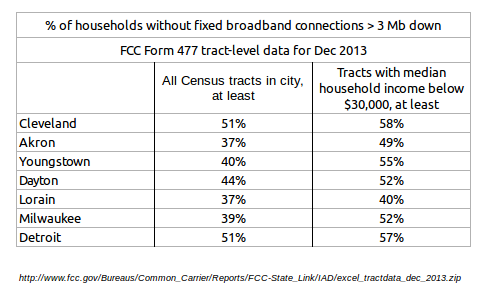
Includes some updated FCC Form 477 data for seven cities served by Coalition members:
Friday, December 26, 2014
Data wants to be free
From an article posted Sunday in Daily Detroit:

Look familiar? That very, very fine print at the very end is the credits.
Wednesday, November 12, 2014
Mapping the worst-connected
Taking a cue from Huff Post, here's a similar map showing only the cities where more than 30% of households said they had no home Internet access of any kind in 2013.
Notice anything interesting about the geography?
Notice anything interesting about the geography?
Friday, November 7, 2014
Worst-connected = poorest
America's worst-connected cities are also the poorest, pretty much.
The 2013 American Community Survey shows 72 U.S. cities with 100,000 households or more. Here are the fifteen with the highest percentages of households with no Internet access of any kind, including mobile or dial-up.
The rightmost column shows each city's rank among the 72 in median household income, lowest to highest. (The median for all U.S. households was $51,017.)
 Remember, "median income" means half of all households made less.
So... pretty straightforward, yes?
And not surprising. There's plenty of evidence of correlation, if not causation, between low income and lack of Internet access and use.
Does this correlation prove that the cost of broadband service is the main reason so many households still don't have it? Nope, not by itself.
But bear in mind that it's pretty hard in most communities to buy any kind of Internet connection, including "non-subscription" smartphone service, for less than $25 a month... which is not small change for a household with only $1200 or $1500 a month to live on.
The 2013 American Community Survey shows 72 U.S. cities with 100,000 households or more. Here are the fifteen with the highest percentages of households with no Internet access of any kind, including mobile or dial-up.
The rightmost column shows each city's rank among the 72 in median household income, lowest to highest. (The median for all U.S. households was $51,017.)
So... pretty straightforward, yes?
And not surprising. There's plenty of evidence of correlation, if not causation, between low income and lack of Internet access and use.
Does this correlation prove that the cost of broadband service is the main reason so many households still don't have it? Nope, not by itself.
But bear in mind that it's pretty hard in most communities to buy any kind of Internet connection, including "non-subscription" smartphone service, for less than $25 a month... which is not small change for a household with only $1200 or $1500 a month to live on.
Wednesday, November 5, 2014
America's worst-connected big cities: The whole list
A couple of readers have asked me to post my whole list of 176 U.S. cities with their "worst-connected" ranks.
Here are both versions of the complete rankings in PDF format, ready to download.
Here are both versions of the complete rankings in PDF format, ready to download.
Percentage of households without fixed broadband subscriptions – 176 U.S. cities with 50,000 or more households
Percentage of households with no Internet access – 176 U.S. cities with 50,000 or more households
Monday, November 3, 2014
America's worst-connected big cities
As mentioned in a previous post, the first numbers from the U.S. Census American Community Survey for 2013 were released in September and they included -- for the very first time! -- data on household Internet connections.
Eventually we'll have ACS numbers down to the Census tract level, but for now we only have them for the 575 U.S. "places" (i.e. cities) with populations of 65,000 or more. Among these cities are 176 that have 50,000 or more residential households.
In the last couple of days, I downloaded the 2013 household Internet data for these 176 larger cities from here, and did the math to rank them by two measures of household "non-connectedness":
- the percentage of each city's households that lacked home Internet access of any kind, including dial-up accounts and mobile device access (like smartphone access)
- the percentage of households that lacked what the FCC calls "fixed broadband subscriptions", i.e. direct Internet access through DSL, cable modem, fiber-to-the-home or satellite accounts (but not counting mobile devices or dial-up).


(If you want to see the whole dataset from which these charts are taken, email me and I'll send you a copy.)
Update 11/4: Phil Dampier has an extended commentary on this post at Stop the Cap!
And... so does Jon Brodkin at Ars Technica.
Thursday, October 2, 2014
GreatLand to FCC: We'll keep Internet Essentials
The infant corporation that hopes to absorb 2.5 million Comcast customers in Detroit, the Twin Cities and other Great Lakes communities now says it will continue Comcast's Internet Essentials program, which provides $10-a-month broadband service to families of schoolchildren who qualify for subsidized school lunches.
And Charter Communications, which proposes to take over Time Warner Cable markets in Ohio, Kentucky, and metropolitan Milwaukee, says it also plans to start offering low-cost service for low-income households.
In joint "reply comments" filed with the FCC on September 24 but not posted publicly until Tuesday, Charter and "Midwest Cable LLC" -- another name for GreatLand Connections, the new "Comcast spinoff" created as part of the pending Comcast-TimeWarner-Charter deal -- say the following:
And Charter Communications, which proposes to take over Time Warner Cable markets in Ohio, Kentucky, and metropolitan Milwaukee, says it also plans to start offering low-cost service for low-income households.
In joint "reply comments" filed with the FCC on September 24 but not posted publicly until Tuesday, Charter and "Midwest Cable LLC" -- another name for GreatLand Connections, the new "Comcast spinoff" created as part of the pending Comcast-TimeWarner-Charter deal -- say the following:
VI. RESIDENTS IN UNDERSERVED COMMUNITIES WILL BENEFIT FROM THE TRANSACTIONS. In light of the synergies and other benefits flowing from the Divestiture Transactions, Charter intends to launch a program following the closing of the Divestiture Transactions that offers low-cost broadband service to low-income families. Charter looks forward to workingwith interested stakeholders as it designs this program. GreatLand will continue to offer Internet Essentials and, over time, may make changes to properly serve this important constituency.These assurances, which are new, are apparently a response to questions raised by the Coalition for Broadband Equity in comments with the FCC in August. The Coalition -- which includes community groups in Detroit as well as public and nonprofit organizations in several communities slated for "divestiture" to Charter -- asked the FCC to clarify whether the two companies plan to continue Internet Essentials as well as a low-end Internet service tier currently offered by Time Warner, and to require them to do so if necessary as part of any decision approving the overall Comcast-TimeWarner-Charter deal.
Saturday, September 20, 2014
2013 Census data includes household broadband; half of Cleveland households don't have it
The U.S. Census has finally gotten around to including households' computer and Internet situations in its annual American Community Survey. The first release of 2013 ACS data came out on Thursday, and it included responses to this question series (h/t Pew Internet):

So here's the Cleveland headline: About 51% of Cleveland's households still didn't have "fixed" broadband accounts (i.e. cable modem, DSL, satellite, etc.) in 2013. And even counting mobile devices, 45% of the city's households didn't have broadband Internet accounts.
Using the new ACS data, I worked up a quick chart of the distribution of Cleveland's "broadband haves and have-nots" by household income:
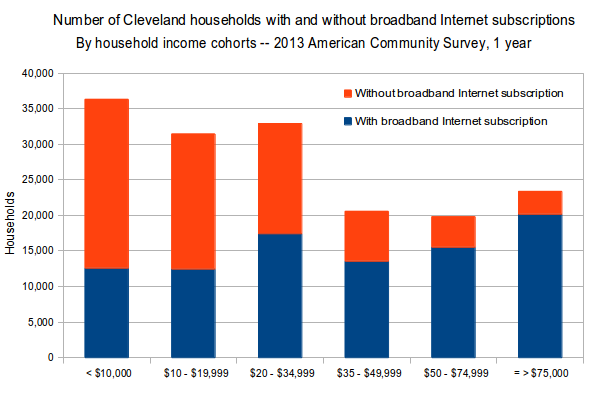 Pretty revealing, yes?
(61% of Cleveland households had incomes below $35,000 in 2013.)
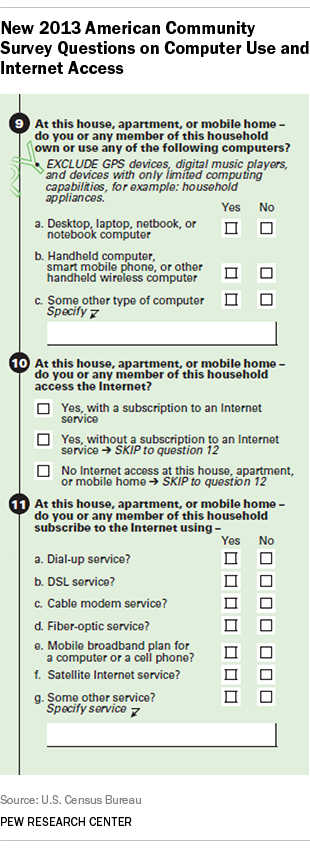
So here's the Cleveland headline: About 51% of Cleveland's households still didn't have "fixed" broadband accounts (i.e. cable modem, DSL, satellite, etc.) in 2013. And even counting mobile devices, 45% of the city's households didn't have broadband Internet accounts.
Using the new ACS data, I worked up a quick chart of the distribution of Cleveland's "broadband haves and have-nots" by household income:
(61% of Cleveland households had incomes below $35,000 in 2013.)
Sunday, August 31, 2014
Comcast deal could end $10 broadband for low-income K-12 families in Detroit, Twin Cities
When asked to describe the public benefits of their controversial plan to buy out Time Warner Cable, Comcast executives eagerly point to the expansion of Internet Essentials, Comcast's three-year-old program that provides $10 broadband accounts to families with children who qualify for Federal school lunch subsidies. If the Time Warner deal is allowed, Comcast promises the program will continue to expand its user base of low-income households in its current market areas -- now pegged at about 300,000 -- and expand aggressively in the former Time Warner markets as well.
Comcast's rosy version of Internet Essentials' impact has drawn some skeptical press from tech-consumerist sites like Ars Technica and the Center for Public Integrity, as well as proposals for improvement and accountability from the Mayor of New York City and the California Emerging Technology Fund among others.
But even this handful of skeptics -- not to mention the hundreds of reporters breathlessly covering the Comcast deal for the tech, business, political and general media -- have failed to to notice that one of the first effects of the deal, if greenlighted by the FCC, will be to terminate $10 Internet Essentials service for tens of thousands of poor families who are already using it.
These families are among the 2.5 million customers whom Comcast is proposing to "spin off" to a newly formed cable Internet corporationtemporarily called "SpinCo" to be called "GreatLand Connections".
SpinCo GreatLand is part of a maneuver to reduce Federal antitrust barriers to the Comcast-Time Warner merger. (The maneuver also includes the sale of Time Warner systems in Ohio, Kentucky and Wisconsin to Charter Communications.) Comcast shareholders would get a majority of SpinCo GreatLand's initial stock, but the board, management and operations would all be independent of Comcast.
So households in the affected communities -- including Detroit and other cities in Michigan, Minneapolis-St. Paul, much of Indiana, and parts of Kentucky, Tennessee, Southern Illinois and Alabama -- would no longer be Comcast customers...
...and therefore, no longer eligible for Internet Essentials.
Comcast's only public acknowledgment of this issue is an obscure footnote in Congressional testimony presented in May by Comcast's David Cohen and Time Warner's Robert Marcus. The footnote (number 38, at the bottom of page 19) says in its entirety:
SpinCo GreatLand should choose not to continue Internet Essentials, how many low-income families would lose the benefits of the program -- particularly the 5-mbps-down Internet service they're now getting for $10 a month?
The two biggest urban centers on theSpinCo GreatLand divestment list are Detroit and Minneapolis-St. Paul.
SpinCo GreatLand territories, and many parents of low-income schoolchildren who don't live in cities of any size but may have signed up for IE. If 17,500 or more families in just Detroit and the Twin Cities stand to lose IE when Comcast leaves town, what might be the total for all affected communities? 25,000? 30,000? More than a tenth of Internet Essentials' total 300,000 participants? Even as collateral damage, that's a lot of poor families to unceremoniously dump from your signature digital divide program.
The issue has now been raised to the FCC by a group of public and community organizations called the Coalition for Broadband Equity, whose members include two community agencies in Detroit with heavy involvement in broadband training and adoption efforts. (Yes, CBE is a project of Connect Your Community 2.0, which I staff.) Our comments filed last last Monday in the Comcast-TimeWarner-Charter-Spinco docket outline the problem, and ask the Commission to:
(Note: Jon Brodkin of Ars Technica is a marginal exception to my "failed to notice" generalization; after I contacted him about it, he mentioned the issue briefly in this story.)
Comcast's rosy version of Internet Essentials' impact has drawn some skeptical press from tech-consumerist sites like Ars Technica and the Center for Public Integrity, as well as proposals for improvement and accountability from the Mayor of New York City and the California Emerging Technology Fund among others.
But even this handful of skeptics -- not to mention the hundreds of reporters breathlessly covering the Comcast deal for the tech, business, political and general media -- have failed to to notice that one of the first effects of the deal, if greenlighted by the FCC, will be to terminate $10 Internet Essentials service for tens of thousands of poor families who are already using it.
These families are among the 2.5 million customers whom Comcast is proposing to "spin off" to a newly formed cable Internet corporation
So households in the affected communities -- including Detroit and other cities in Michigan, Minneapolis-St. Paul, much of Indiana, and parts of Kentucky, Tennessee, Southern Illinois and Alabama -- would no longer be Comcast customers...
...and therefore, no longer eligible for Internet Essentials.
Comcast's only public acknowledgment of this issue is an obscure footnote in Congressional testimony presented in May by Comcast's David Cohen and Time Warner's Robert Marcus. The footnote (number 38, at the bottom of page 19) says in its entirety:
Because Comcast will no longer control the cable systems in the markets being divested, it will no longer be able to support Internet Essentials in those communities, although SpinCo could choose to continue the program.If the as-yet-nonexistent but independent
The two biggest urban centers on the
- According to a Comcast press release reported by Fierce Cable, 5,800 of the 150,000 familes enrolled in IE at the end of 2012 lived in Detroit. "Detroit has seen the highest penetration of the 3 Mbps service, with 11.5 percent of eligible households signing up, Cohen said." Since Detroit reached this number in IE's first sixteen months, covering one school year and the beginning of the next, it seems pretty likely that the city's current enrollment total after three full years is at least 10,000 families.
- Another Comcast press release, from September 2013, announced that "More than 5,200 Twin Cities Families Have Enrolled in Internet Essentials". That was at the beginning of the program's Year 3, with 220,0000 total signups across the country. So conservatively, there are probably at least 7,500 families now participating in Internet Essentials in Minneapolis and St. Paul.
The issue has now been raised to the FCC by a group of public and community organizations called the Coalition for Broadband Equity, whose members include two community agencies in Detroit with heavy involvement in broadband training and adoption efforts. (Yes, CBE is a project of Connect Your Community 2.0, which I staff.) Our comments filed last last Monday in the Comcast-TimeWarner-Charter-Spinco docket outline the problem, and ask the Commission to:
...clarify the Applicants' intentions with respect to continued availability of discounted Internet Essentials broadband service, or its equivalent, to families of children eligible for free or discounted school lunches in Detroit and other communities which Comcast proposes to transfer to SpinCo... If the Commission determines that the Applicants do not plan to provide Internet Essentials or an equivalent program (e.g. provided by SpinCo) for these families, then we ask that the Applicants be required to do so as a condition of approving the Applications.Stay tuned.
(Note: Jon Brodkin of Ars Technica is a marginal exception to my "failed to notice" generalization; after I contacted him about it, he mentioned the issue briefly in this story.)
Sunday, July 20, 2014
New FCC map of household broadband penetration
On June 14 the FCC released its semi-annual report on "Local Telephone Competion and Broadband Deployment", based on providers' Form 477 filings from June 2013. As usual, the new report includes data comparing the number of home broadband connections, as reported by the providers, to the total households in each county and Census Tract.
But something new has been added. For the first time, the FCC has provided its broadband-connections-to-households comparison using a meaningful definition of "broadband" speed -- at lead 3 mbps down and 768 kbps up.
While still conservative for 2014, this new benchmark tells us, for the first time, about Americans' access to a level of home Internet access that's actually worth paying for.
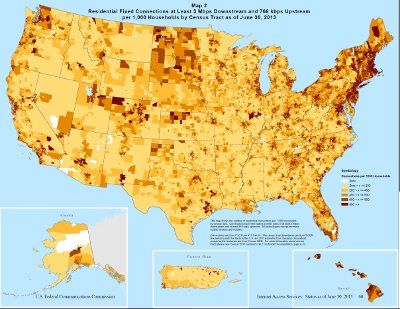
Here's the new report's national map of "Residential Fixed Connections at Least 3 Mbps Downstream and 768 kbps Upstream per 1,000 Households by Census Tract".
Here's a closer view of Ohio.
And here's my own more detailed map of Cleveland and Cuyahoga County, highlighting the tracts where reported broadband connections in June 2013 accounted for fewer than 40% of total households.
But something new has been added. For the first time, the FCC has provided its broadband-connections-to-households comparison using a meaningful definition of "broadband" speed -- at lead 3 mbps down and 768 kbps up.
While still conservative for 2014, this new benchmark tells us, for the first time, about Americans' access to a level of home Internet access that's actually worth paying for.
Here's the new report's national map of "Residential Fixed Connections at Least 3 Mbps Downstream and 768 kbps Upstream per 1,000 Households by Census Tract".

Here's a closer view of Ohio.
And here's my own more detailed map of Cleveland and Cuyahoga County, highlighting the tracts where reported broadband connections in June 2013 accounted for fewer than 40% of total households.
Wednesday, May 22, 2013
Karen Mossberger at City Club June 28
OneCommunity's new broadband speakers series at the Cleveland City Club will kick off June 28 with Dr. Karen Mossberger, one of the lead researchers on our October 2012 Cuyahoga County Survey of Internet Access and Use.
Dr. Mossberger, who chairs the Department of Public Administration at the University of Illinois at Chicago, partnered on the Cuyahoga County study with Dr. Caroline Tolbert of the University of Iowa, a frequent collaborator. The two are co-authors of several pioneering books on digital divide issues including the recent Digital Cities: The Internet and the Geography of Opportunity.
Dr. Mossberger, who chairs the Department of Public Administration at the University of Illinois at Chicago, partnered on the Cuyahoga County study with Dr. Caroline Tolbert of the University of Iowa, a frequent collaborator. The two are co-authors of several pioneering books on digital divide issues including the recent Digital Cities: The Internet and the Geography of Opportunity.
Subscribe to:
Posts (Atom)