Thursday, October 2, 2014

GreatLand to FCC: We'll keep Internet Essentials

The infant corporation that hopes to absorb 2.5 million Comcast customers in Detroit, the Twin Cities and other Great Lakes communities now says it will continue Comcast's Internet Essentials program, which provides $10-a-month broadband service to families of schoolchildren who qualify for subsidized school lunches.

And Charter Communications, which proposes to take over Time Warner Cable markets in Ohio, Kentucky, and metropolitan Milwaukee, says it also plans to start offering low-cost service for low-income households.

In joint "reply comments" filed with the FCC on September 24 but not posted publicly until Tuesday, Charter and "Midwest Cable LLC" -- another name for GreatLand Connections, the new "Comcast spinoff" created as part of the pending Comcast-TimeWarner-Charter deal -- say the following:
VI. RESIDENTS IN UNDERSERVED COMMUNITIES WILL BENEFIT FROM THE TRANSACTIONS. In light of the synergies and other benefits flowing from the Divestiture Transactions, Charter intends to launch a program following the closing of the Divestiture Transactions that offers low-cost broadband service to low-income families. Charter looks forward to workingwith interested stakeholders as it designs this program. GreatLand will continue to offer Internet Essentials and, over time, may make changes to properly serve this important constituency.
These assurances, which are new, are apparently a response to questions raised by the Coalition for Broadband Equity in comments with the FCC in August. The Coalition -- which includes community groups in Detroit as well as public and nonprofit organizations in several communities slated for "divestiture" to Charter -- asked the FCC to clarify whether the two companies plan to continue Internet Essentials as well as a low-end Internet service tier currently offered by Time Warner, and to require them to do so if necessary as part of any decision approving the overall Comcast-TimeWarner-Charter deal.

Saturday, September 20, 2014

2013 Census data includes household broadband; half of Cleveland households don't have it

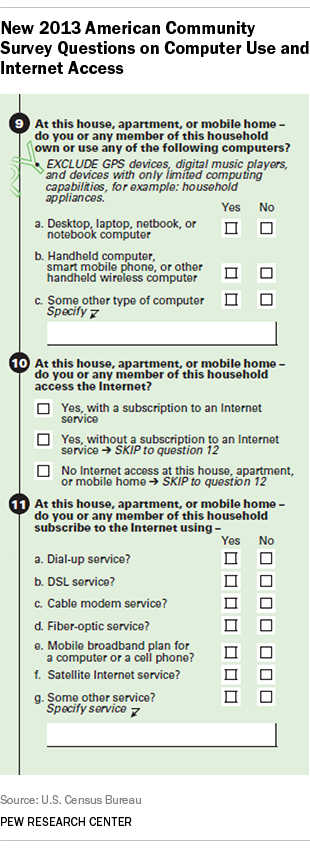
The U.S. Census has finally gotten around to including households' computer and Internet situations in its annual American Community Survey.  The first release of 2013 ACS data came out on Thursday, and it included responses to this question series (h/t Pew Internet):


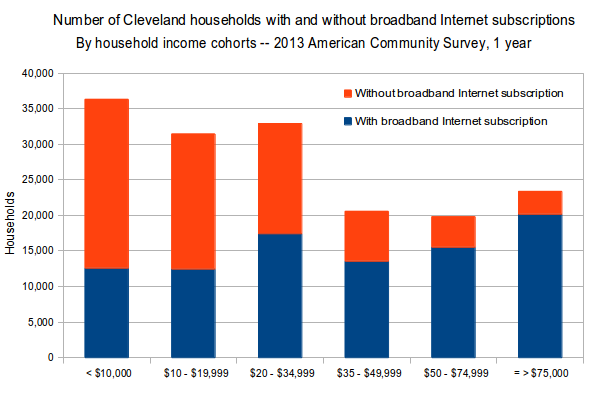
So here's the Cleveland headline: About 51% of Cleveland's households still didn't have "fixed" broadband accounts (i.e. cable modem, DSL, satellite, etc.) in 2013.  And even counting mobile devices, 45% of the city's households didn't have broadband Internet accounts.

Using the new ACS data, I worked up a quick chart of the distribution of Cleveland's "broadband haves and have-nots" by household income:

Pretty revealing, yes?

(61% of Cleveland households had incomes below $35,000  in 2013.)

Sunday, August 31, 2014

Comcast deal could end $10 broadband for low-income K-12 families in Detroit, Twin Cities

When asked to describe the public benefits of their controversial plan to buy out Time Warner Cable, Comcast executives eagerly point to the expansion of Internet Essentials, Comcast's three-year-old program that provides $10 broadband accounts to families with children who qualify for Federal school lunch subsidies. If the Time Warner deal is allowed, Comcast promises the program will continue to expand its user base of low-income households in its current market areas -- now pegged at about 300,000 -- and expand aggressively  in the former Time Warner markets as well.

Comcast's rosy version of Internet Essentials' impact has drawn some skeptical press from tech-consumerist sites like Ars Technica and the Center for Public Integrity, as well as proposals for improvement and accountability from the Mayor of New York City and the California Emerging Technology Fund among others.

But even this handful of skeptics -- not to mention the hundreds of reporters breathlessly covering the Comcast deal for the tech, business, political and general media -- have failed to to notice that one of the first effects of the deal, if greenlighted by the FCC, will be to terminate $10 Internet Essentials service for tens of thousands of poor families who are already using it.

These families are among the 2.5 million customers whom Comcast is proposing to "spin off" to a newly formed cable Internet corporation temporarily called "SpinCo" to be called "GreatLand Connections".

SpinCo GreatLand is part of a maneuver to reduce Federal antitrust barriers to the Comcast-Time Warner merger.  (The maneuver also includes the sale of Time Warner systems in Ohio, Kentucky and Wisconsin to Charter Communications.) Comcast shareholders would get a majority of SpinCo GreatLand's initial stock, but the board, management and operations would all be independent of Comcast.

So households in the affected communities -- including Detroit and other cities in Michigan, Minneapolis-St. Paul, much of Indiana, and parts of Kentucky, Tennessee, Southern Illinois and Alabama -- would no longer be Comcast customers...

...and therefore, no longer eligible for Internet Essentials.

Comcast's only public acknowledgment of this issue is an obscure footnote in  Congressional testimony presented in May by Comcast's David Cohen and Time Warner's Robert Marcus.  The footnote (number 38, at the bottom of page 19) says in its entirety:
Because Comcast will no longer control the cable systems in the markets being divested, it will no longer be able to support Internet Essentials in those communities, although SpinCo could choose to continue the program.
If the as-yet-nonexistent but independent SpinCo GreatLand should choose not to continue Internet Essentials, how many low-income families would lose the benefits of the program -- particularly the 5-mbps-down Internet service they're now getting for $10 a month?

The two biggest urban centers on the SpinCo GreatLand divestment list are Detroit and Minneapolis-St. Paul.
  • According to a Comcast press release reported by Fierce Cable, 5,800 of the 150,000 familes enrolled in IE at the end of 2012 lived in Detroit. "Detroit has seen the highest penetration of the 3 Mbps service, with 11.5 percent of eligible households signing up, Cohen said." Since Detroit reached this number in IE's first sixteen months, covering one school year and the beginning of the next, it seems pretty likely that the city's current enrollment total after three full years is at least 10,000 families.
  • Another Comcast press release, from September 2013, announced that "More than 5,200 Twin Cities Families Have Enrolled in Internet Essentials". That was at the beginning of the program's Year 3, with 220,0000 total signups across the country. So conservatively, there are probably at least 7,500 families now participating in Internet Essentials in Minneapolis and St. Paul.
Of course there are many smaller cities in the proposed SpinCo GreatLand territories, and many parents of low-income schoolchildren who don't live in cities of any size but may have signed up for IE.  If 17,500 or more families in just Detroit and the Twin Cities stand to lose IE when Comcast leaves town, what might be the total for all affected communities?  25,000?  30,000?  More than a tenth of Internet Essentials' total 300,000 participants? Even as collateral damage, that's a lot of poor families to unceremoniously dump from your signature digital divide program.

The issue has now been raised to the FCC by a group of public and community organizations called the Coalition for Broadband Equity, whose members include two community agencies in Detroit with heavy involvement in broadband training and adoption efforts. (Yes, CBE is a project of Connect Your Community 2.0, which I staff.)  Our comments filed last last Monday in the Comcast-TimeWarner-Charter-Spinco docket outline the problem, and ask the Commission to:
...clarify the Applicants' intentions with respect to continued availability of discounted Internet Essentials broadband service, or its equivalent, to families of children eligible for free or discounted school lunches in Detroit and other communities which Comcast proposes to transfer to SpinCo... If the Commission determines that the Applicants do not plan to provide Internet Essentials or an equivalent program (e.g. provided by SpinCo) for these families, then we ask that the Applicants be required to do so as a condition of approving the Applications.
Stay tuned.

(Note: Jon Brodkin of Ars Technica is a marginal exception to my "failed to notice" generalization; after I contacted him about it, he mentioned the issue briefly in this story.)

Sunday, July 20, 2014

New FCC map of household broadband penetration

On June 14 the FCC released its semi-annual report on "Local Telephone Competion and Broadband Deployment", based on providers' Form 477 filings from June 2013.  As usual, the new report includes data comparing the number of home broadband connections, as reported by the providers, to the total households in each county and Census Tract.

But something new has been added.  For the first time, the FCC has provided its broadband-connections-to-households comparison using a meaningful definition of "broadband" speed -- at lead 3 mbps down and 768 kbps up.

While still conservative for 2014, this new benchmark tells us, for the first time, about Americans' access to a level of home Internet access that's actually worth paying for.

Here's the new report's national map of "Residential Fixed Connections at Least 3 Mbps Downstream and 768 kbps Upstream per 1,000 Households by Census Tract".


Here's a closer view of Ohio.

And here's my own more detailed map of Cleveland and Cuyahoga County, highlighting the tracts where reported broadband connections in June 2013 accounted for fewer than 40% of total households.

Wednesday, May 22, 2013

Karen Mossberger at City Club June 28

OneCommunity's new broadband speakers series at the Cleveland City Club will kick off June 28 with Dr. Karen Mossberger, one of the lead researchers on our October 2012 Cuyahoga County Survey of Internet Access and Use.

Dr. Mossberger, who chairs the Department of Public Administration at the University of Illinois at Chicago, partnered on the Cuyahoga County study with Dr. Caroline Tolbert of the University of Iowa, a frequent collaborator.  The two are co-authors of several pioneering books on digital divide issues including the recent Digital Cities: The Internet and the Geography of Opportunity.

Friday, May 17, 2013

Study: Low-income patients want online links to health providers

From EHR Intelligence, February 28 ("EHR" means "electronic health records"):

71% of safety net patients want email, texts, and portals

A large majority of low income, underserved, and safety net patients want to communicate with their providers using email, text messaging, and online patient portals, according to a new study published in the Journal of General Internal Medicine, but fewer than 20% actually do. “A significant majority of safety net patients currently use email, text messaging, and the internet, and they expressed an interest in using these tools for electronic communication with their medical providers,” wrote the authors. “This interest is currently unmet within safety net clinics that do not offer a patient portal or secure messaging.”
The study was conducted in San Francisco.  In Cleveland, most "safety net" providers (MetroHealth, Neighborhood Family Practice, NEON, Care Alliance, etc.) do offer online communication, scheduling, prescription renewal and records access to their patients -- most often in the form of an integrated application like MyChart.

But the usefulness of these services to low-income and elderly patients in greater Cleveland is severely limited by the fact that most of them don't have regular Internet access.

Here comes the digital divide in banking

The City of Cleveland is getting very concerned about losing neighborhood bank branches, as some big banks look to reduce costs by pushing ever bigger shares of their customer interactions on line. A recent survey conducted for the Board of Governors of the Federal Reserve is apparently being cited in the industry as evidence that the mobile Internet offers a better way to reach "the unbanked" with financial services than continued support for physical branches in poor communities.

At the City's invitation, Samantha Cycyk and I spoke yesterday to a gathering of neighborhood development organization staff about the results of OneCommunity's recent Cuyahoga County Broadband Inclusion Survey. Samantha put together a presentation outlining the large number of Cleveland residents -- especially older and lower-income residents -- who still have no regular access to the Internet, as well as the very limited impact of mobile Net access on Clevelanders who are otherwise unconnected.  The point being, of course:  When more than 40% of adults in the city don't have home broadband, and more than a third don't have either home broadband or mobile Internet access, how do you swap a local branch for a web page without cutting off access for a lot of current and potential customers?

Here's the presentation (in PDF format, click to open):